Welcome

I am Rod Wynne-Powell, and this is my way to pass on snippets either of a technical nature, or related to what I am currently doing or hope to be doing in the near future.

A third-person description follows:
Professional photographer, Lightroom and Photoshop Workflow trainer, Consultant, digital image retoucher, author, and tech-editor for Martin Evening's many 'Photoshop for Photographers' books.

For over twenty years, Rod has had a client list of large and small companies, which reads like the ‘who’s who’ of the imaging, advertising and software industries. He has a background in Commercial/Industrial Photography, was Sales Manager for a leading London-based colour laboratory and has trained many digital photographers on a one-to-one basis, in the UK and Europe.
Still a pre-release tester for Adobe in the US, for Photoshop, he is also very much involved in the taking of a wide range of photographs, as can be seen in the galleries.

See his broad range of training and creative services, available NOW. Take advantage of them and ensure an unfair advantage over your competitors…


View any Gallery by Clicking the relevant TEXT Headline

Showing posts with label pigeon. Show all posts

Wednesday, 27 October 2021

Milton Ernest - Riverbank Garden

          I recently spent a restful afternoon in and beyond, a friend’s garden — taking photos of the plants, flowers and other life that caught my eye. It was impossible to miss the most abundant colour after green and, normally after golden brown, is one of the natural features of the Autumn season — red berries — which were cascading in profusion from the branches of several trees.
          The stone wall dividing the gardens from the grassy walk to the river’s edge was draped in ivy whose trailing tendrils were seeking to find moisture further afield than dry stone. My eye was caught by a lone bee patiently ignoring my close proximity, that was single-mindedly intent on searching for nectar from the wild roses within the hedge; spending some time attempting to prise apart, the protective petals to reach its precious cargo.
          Is there some significance in this year’s large number of red berries? Are we destined for a cold, long Winter? Or is this feature a result of simply the preceding seasons’ affect on the soil constituents?

Answers on a postcard… Meantime I will revel in the opportunity given me, to capture fine detail of the lone, patient bee as it spent time on wild rose blooms.

Sunday, 2 May 2021

Maulden Afternoon Visit – Somewhat Random Images

Some days do not turn out as expected, but in the present situation I find myself, it seemed not unreasonable to go with the flow when I found it difficult to find the spot where the map seemed to indicate a lake. The young lady who was engaged in dropping leaflets through letter boxes, seemed the ideal person to ask for help, as I was assuming her local knowledge would provide the answer. She very kindly took a look on her phone, whose screen was far larger than mine, and gave me some directions, for which I thanked her, and headed in that direction.

Sadly, I must have slipped up along the way, for I found no indication of the proposed destination, however, I did spot something that caught my eye — I often see trees that have been the site of an abundance of balls of mistletoe, but never so many as seven different sizes on a single tree. I pulled up and parked on a widened area of verge, and attached my EOS R6 to the 24—70mm lens. I was assisted for part of the time by sunshine bringing some detail to the spherical growth of this parasite.

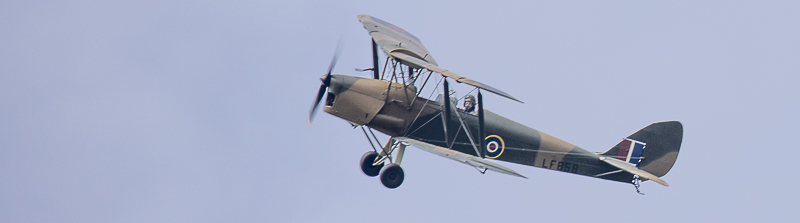
As a direct result of this distraction, I eventually came to the village of Maulden, where I parked near the green close by where a fellow photographer I used to know once lived. I made a quick call to mention where I happened to be, and surprisingly, he greeted me by name, so he must have recognised my number! We had quite a chat, even though it has to be at least seven years since we last spoke! After the call, I continued shooting occasionally walking to different spots to capture both human and bird activity and various plants I came across that appealed to my eye. Since I had got a shot of a girl walking her horse, and was within hailing distance, I asked whether she minded my photographing her, to which she had no complaint. Although I took a shot of a light aircraft with the short focal length lens, it was a testament to how good both the camera and lens performs as its number and propeller blade are visible. The pigeon on the distant roof ridge were on the 60-600mm, which would not have fared as well on the shorter zoom lens.

Altogether, an enjoyable excursion with pleasing results, and both lenses justifying my choice to have to hand. Obviously, the longer lens had it been attached at the time would have made a considerable difference to the light aircraft shot, but that it resolved the propeller blade was still a testament to both camera and lens.


For the observant among you, I apologise for not correcting the text to the blog gallery text which repeats itself at the end (dittographic error!) but sadly may I just apologise, as altering it at present will give grief to my son in law, who is kindly helping me out… Put it down to falling dominoes in 'anno domini' ! Try not reading the titles, and look at the pictures instead. Note to teacher:  I must try harder, Sir!


Friday, 2 April 2021

Walk around Willington

I needed to be outside in the fresh air, and I decided to go to a spot on the river close to the Danish Camp and the Dovecote Building, but to take a different route from that which I had taken on earlier occasions. I parked my car a short walk from the Dovecote, and with my camera with the 60-600mm on the EOS R6 attached to my monopod, and a camera bag over my shoulder with a shorter lens with its macro facility within I took to a path via a gate that once open fell several inches, making closing it a struggle as it was a bit of a juggle to lift back when closing. Little did I realise I was destined to retrace my steps because my battery was lower than expected, and worse still was my backup battery was also fully discharged! Fortunately there was another back in my car, and that was fully charged. Hardly the mark of a professional! So the walk of Shame was justified. The time lost and energy consumed meant that less time was spent in sunshine.

Although I was hearing birdsong for much of the afternoon, I only occasionally actually was able to catch sight of the songsters, and only to glimpse a speedy low level flight from one bush side of my path to the other. The only bird that did feature was a pigeon, and it kept a wary eye on me and only allowed me a chance to move sideways to better frame it, at the hint of a move closer it took flight! 

There had either been less rain here or recent winds had dried the paths, for the going was the best I had encountered for a couple of weeks elsewhere. The greens were bright here, and the paths were winding making pleasing compositions, and the better weather had brought out canoeists that I was able to capture by moving to gaps in the tree cover when alerted to the sounds of their paddles. At one stage I was able to get a couple of shots of some mandarin ducks, and due to the long lens the chain link fence was rendered out of focus that gave the birds the chance to feel safe and ignore my presence.

On my return journey, I managed to miss the point at which I joined the path, and even had to ask a family group directions back to the Dovecote — I am glad I asked, because without their guidance I might well have taken a different choice and added even further to the distance I travelled to return to the car, and my back was definitely beginning to ache from the camera and rucksack. It was undoubtedly a good choice to use the monopod rather than a tripod, because it was sufficiently stable in the prevailing light levels.

I had enjoyed the chance of the fresh air and the exercise, and felt that the photographs I had managed to take were a good record of the time spent.

Saturday, 30 March 2019

Harrold-Odell Country Park Birds

 
I now had the EOS R mirrorless camera and Sigma Sports 60-600mm lens back, and was keen to set everything up again, and also having learned from Canon how to shoot sequences with breaks in shooting, without the interruption of the saved files in the viewfinder until I needed to review the captured images. I did not find it as fluid as when using a conventional DSLR, but with practice I believe I will manage to master it. When you learn how to set this up, it is straightforward, but I had to find the setting by asking my Canon Guru!
Now if I need to review the image I click Preview rather than have to wait as the sequence is displayed in the viewfinder, when what I was trying to do was continue shooting once an action continued. Thus far it is not as fluid as my earlier experience with a mirror flipping, but I am hoping I will master it with more practice. One piece of advice offered was to slow the frame rate, but that would seem counter-intuitive, but I will explore all this as every opportunity arrives. What I have already found is that the quality of the captured images exceeds that of the earlier lenses due to the reduced camera shutter vibration and the larger inherent file size; in other words the image quality exceeds what I previously achieved. Another factor also comes into play in low light levels; the image brightness improves both the cameras ability and mine to focus accurately.
The adapter to use my existing investment in lenses is yet another benefit of the move to a mirrorless body, but it has been a steep learning curve, and as yet I do not have the fluidity I experienced with my earlier bodies (and my brain is older, and less tractable!) My own body has a similar issue with my wonderfully stable Benbo tripod, whose weight is a severe issue when travelling on foot for any distance!
On this trip the only bird that was in any way special was a lone Grebe, but the trip was mainly an exercise to gain confidence in the mirrorless body and the Sigma 60-600mm lens, which I fulfilled albeit not spotting the incorrect setting of colour temperature, which fortunately I was able to sort in ‘post’! I still have further settings to reinstate, but for anyone considering the change to the EOS R, fear not.

Friday, 16 March 2018

Marston Moretaine – Bus Stop Birds in the Bushes

 
On returning down Station Road, having posted a letter, the cacophony of birds in the bushes by the bus stop was to tempting a sight to ignore, so my return trip was at a brisker pace as I considered grabbing my medium weight tripod putting on the gimbal head and the Sigma 150-600 Sports lens and seeing what I might catch in the sunshine.

When I returned equipped, I noticed that there were the first signs of blossom on the branches, and the chirruping was still as busy as when I had passed before, so I just hoped that my presence was not going to be the kiss of death to my chances of capturing some shots of the birds I had spotted earlier.

To give myself a good chance, I had brought along some seeds to establish I was there to show my potential subjects some generosity, and I liberally spread handfuls close to the bushes but at a good distance from where I had set down the tripod.

The bushes were a mass of fine branches, which I knew would make it tough to capture the birds without intervening branches coming between myself and the birds, but there again it was probably also the reason why the birds felt moderately secure. It was not too long before some of the birds began returning, giving me a chance to see what I could capture, there seemed to be house sparrows and starlings as far as I could tell, with the very occasional pigeon coming in, but though I was not going to take shots of them in the bush, When one settled on a nearby roof ridge, I did sneak a couple of shots since it’s arrival in the bushes had caused a few starlings to make a swift exit, leaving them bare of birds.

I stayed a while and was occasionally involved in conversation from passers by, my next door neighbour heading home to collect her children from school, and a mother and young child, who informed me the bushes were hers, so I showed her and the boy a couple of shots on the back of the camera.

Sunday, 17 April 2016

Birds in Two ‘Mars’ Names – Marston Moretaine and Marsworth

The Starlings are an abundant species around Marston Moretaine; at a distance they seem a boring black, but close to, and especially in sunlight they are a magical mixture of iridescent blues and greens and they are often to be heard whistling amongst a gathering on a nearby telegraph pole; their call a Tseeuw, that I have been mimicking in the hope I can attract them closer in order to capture their true colours, and on this Sunday morning in bright sunshine I lured them in with a mixture of toast crumbs from the toaster, seeds and bread I have to cut off in order for my Bloomer bread slices to fit the new toaster (why did I buy a toaster that did not accept my favourite bread loaves? Answer – because an even browning was more important, and cutting a sliver from each frozen slice meant I had a fresh source of feed for the birds – QED!)

Reckoning that English Weather Forecasts are notorious for unpredictability, I thought I’d take a chance and head for Tring Reservoirs to see how the birdlife there was faring since it was bright from the start and the scheduled later rain might not materialise. Unfortunately I somehow managed to dislodge something in my back and was in considerable pain, but reckoned that no gain without pain, so persevered and headed south cross-country avoiding the M1. I am fortunate in being allowed to park my car with the local anglers and met the Water Bailiff and some of them briefly before heading away from Tringford to Marsworth Lake. It was tough on my back, but the weather was still so good it would have been a shame not to make the attempt and suffer in silence.

I probably spent at least four hours, and all of it standing as I decided on a different spot for a change and sitting was not an option; the pain did not let up and I did have to keep transferring my weight around, but it was manageable and I found that air was alive with all manner of birdcalls, most of which I was unable to place, and certainly most of those calling were never seen. I reckon overall I was lucky in what I managed to capture, even though some birds never succumbed to my trigger finger, even though I had tracked assiduously through the undergrowth – in that category were a Dunnock and Wren, and there were overflying herons and Greylag geese.

However even the pigeon gave me couple of interesting shots as did a robin gathering what I took to be food for its young and he or she was brave because it was straying into the territory of the resident Robin that I regularly spot and sometimes feed (and on a disappointing day, talk to and implore he ask a Kingfisher or Woodpecker to call by!)

To capture a flirting Bluetit pair cavorting, a Long-tailed Tit a Grebe or two and a Kingfisher, I felt was well worth the visit, and I was warm!

Saturday, 9 August 2014

Early Visit to Marsworth Reservoir

Arriving at the water's edge, I immediately spotted a lone Muntjac across the water on the far bank, and just before it returned to the undergrowth managed to grab a quick shot, albeit with foliage and branches obscuring its hind legs, then moments later, a squirrel, scurried down a tree trunk and disappeared into a bush with its mouth full.

The air was filled with the unmistakeable sounds of pigeons' flapping their way through the leaves all around me. The next visitor was far too quick for me, a heron landed momentarily on a high branch of a dead tree, spotted me, and was away back the way it came, in a trice; sadly, never to return that morning. I got to sit down with the camera on a monopod and my hand on the camera with the 70-200mm lens. I have to own up, that was not by choice; I had been careless when packing the case and chose it mistakenly for the 100-400mm, but so be it, it did at least offer an extra full stop of exposure to make up for the far smaller image!

The light was kind to me, it had a softness due to slight cloud cover thereby avoiding the harshness of full sunlight on potential subjects, in this case I was hoping to glimpse a kingfisher. Glimpse was all I got initially, as an orange and blue blur passed across my field of view at high speed, but it was not long before a kingfisher alighted on a far branch, looked around, then dived, and disappeared from view; whether it met with success, I had no way of knowing.

It was quite a while before another visit, so I captured an amusing piece of pigeon life, and it seemed to me as a human observer that a male flew to a branch ostensibly to drink, but in the hope his presence would bring a female admirer, and certainly soon after another pigeon alighted further along the branch, but instead of waiting patiently for a short moment, he immediately sidled along the branch and the second bird simply flew off, he seemed dazed and remained quite still musing on his failure before flying off in the same direction.

I had two more kingfisher visits, and several flybys, together with one quick circling of a bush, and in the lulls, I took shots of some of the fungal growths and the beginnings of autumn in some of the trees, and a charming slim robin gave me the once-over. After four hours I stretched my aching legs and headed for Tringford to meet up with the Water Bailiff, before heading home, but on reaching the turn for Aldbury, changed my mind and took the road heading for Wigginton Bottom.

Saturday, 13 April 2013

Misty Morning at Marsworth


I did not set a particularly early alarm call, because there was no real guarantee of a bright start, but as it turned out it was indeed bright and in many a field hung a blanket of mist, just a few feet above ground.

Arriving at the Tring reservoirs the mist still lay lightly across the reed beds between Startops End and Marsworth reservoirs, and the reeds hardly looked their best, but the light allowed me to capture some of the atmosphere nevertheless, and as I walked the path between the two lakes a robin kept flying a few feet ahead of me as I went along.

When I reached my goal, the lateness took its toll; I realised this by the muddy sliding marks in the steep bank leading to the water’s edge, and there was already another photographer ensconced with similar intentions. Justifiably he had the prime position, but though he had seen a kingfisher do a flypast it had not settled to fish. I set up my tripod alongside, and it was probably a further twenty minutes before we had a chance to get some photographs, and at that first visit, I did not even see it! To add to my chagrin, I then tried to look around for a better, less obstructed view and the kingfisher paid us another visit, so I missed that opportunity, but not so my colleague as I could hear from the rapid shutter firing! I certainly brought him luck.

I resettled and improved the position of the tripod, and managed to be in better luck a few minutes later, and it was around this time that yet another photographer arrived, and not long after, yet another – the lure of capturing the beauty of the kingfisher is obviously strong! Whilst waiting I took some other shots of the local fungi, a pigeon, and a chaffinch.

I later visited Tringford for a chat with the Water Bailiff and some of the anglers, before returning home for lunch.

Monday, 16 July 2012

A Quiet Corner of Startops

There was little bird activity above the Marsworth reservoir as I walked past several anglers relaxing hopefully beside twin lines by the side of the path from Tringford reservoir. Upon the surface there were the usual mallard, coots, and pigeons overflying. So I walked beyond and turned towards Startops. Spotting a flurry of small birds flitting between the bank-based trees and the bushes at the water’s edge in the corner, I watched for a while standing, then walked slowly towards the steps and sat just below the bank side on the top step, and the birds ignored me.

I stayed shooting either side of my vantage point as sparrows and pied wagtails flitted back and forth, often coming quite close to where I sat, before deciding that maybe I could represent danger and flying back from whence they came or looping out over the water and landing just beyond me on the steep banking. They were feeding well on various fly species, but since I never saw them swallow, I presume these were for their offspring possibly in a nest either in the hawthorn or other trees to my left where the branches offered shelter. I have only rarely seen the pigeons come down to the water’s edge, but one did, and foraged in the same area the wagtails and sparrows were frequenting.

Considering sparrows are now so rarely seen, perhaps the conservationists should study this habitat, as they have been flying across this corner for all the years I have visited these three reservoirs; something must suit them.